

Blow Molding

Consulting & Technical Services

   PET Tutorial and on-line training courses  

 
Join the OB Plastics Consulting mailing list
Just send me an e-mail


Blow molding consultant company offers a multitude of services for the production of plastic bottles. I can help you getting started without making costly mistakes or reduce costs in your existing blow molding business. Services offered include:     

  • Minimize your risk by keeping projects on time and on budgetComprehensive Design Guide for PET bottles and closures
  • Reduce your scrap rates and keep your production running with expert trouble-shooting 
  • for the bottle blow molding and preform injection molding process
  • Engineer your new plant lay-out and start it up on time
  • Advise you in newest technologies for optimal production
  • Stay ahead of the competition with product development and plastic bottle design  
  • Assist in proper blow mold and injection mold design and construction                                        
  • Keep your customers satisfied through quality and productivity improvements                                    
  • Give you direction with detailed cost calculations for blow molded plastic bottles 

To download or view an e-brochure of my services, click here and save or open the file.

  • Select and evaluate both primary and secondary equipment for plastic bottle production
  • Maximize your profits with training of personnel in all aspects of blow molding and safety measures
  • Reduce your training costs with on-line training courses
  • Minimize your development time by running computer simulations of the blow molding process
  • Evaluate your plastic bottle for single or two-step process stretch blow molding
  • UN certification of 55 gal. drums and jerrycansPractical book for beginners and professionals
  • Protect your secrets and assist in litigation as Expert Witnesses
  • Write detailed applications for government R & D assistance

Our Business Model

We are only a small company. How can we take on large projects? Rather than employing a lot of staff that would sit idle when there are no new projects we prefer to work with a number of associates on a project basis. We have a network of specialists in just about any area of packaging. During the course of a project we may call on any of them to work out specific problems, Here is a list for your reference. For you as the paying customer this approach has the advantage that we do not need to charge for large overheads. Furthermore, your problems are dealt with by a specialist not by a well-meaning but inexperienced novice in the field. For these reasons we can offer very competitive rates. Give us a try!


Blow Molding: Injection Stretch    Blow Molding: Extrusion                            Blow Molding: Reheat Stretch   
Plastic Bottle Links                     Blow Molding Processor Tips                    Blow Molding Package Development      News

Please have a look around the side with the help of the buttons above. Here are the ways to contact us:

OB Plastics Consulting
434 Oakland Road
Mahone Bay  NS  B0J-2E0 Canada
Tel.: 902-531-2028
Fax: 419-844-7759 

email_ink.gif (3146 bytes) 


Breaking News

Overmoulding

Barrier tec There are various technologies for increasing the barrier performance of PET containers. One of the concepts - overmoulding - has, until now, failed to be successfully applied. However, Netstal-Maschinen AG, in close collaboration with other specialist partners, has succeeded in developing this technology to produce high-quality preforms.hnology for UV light protection


preform


Cross-section of a preform. The grey layer on the inside and the white mark of the support  on the base are visible


kern


Holes created by the core support


One of the proven barrier solutions is the multi-layer preform, produced by co-injection. The manufacturing process starts with the injection of the PET base material into the preform mould. A layer of barrier material is then injected into the still hot and soft core of the PET to create a middle barrier layer. The “conventional” alternatives to multi-layer are (a) the use of PET pre-blended with some secondary barrier material, or (b) coating the bottle after it has been blown. However another possible solution - overmoulding - has, in recent years, been neglected. The overmoulding process starts with the injection of an “inner” preform which is then over-moulded with an additional layer or layers during further process steps.
In the industry the overmoulding process for manufacturing preforms is generally regarded as being both difficult and complex. The reasons for this are as follows: for efficient manufacture with this technology each individual layer must have a very thin wall thickness. However, as a result of pressure differences, the core can be displaced from the central axis. Consequently, the distribution of the wall thickness is no longer guaranteed. Furthermore, after the first cycle, the preform body has to be transferred to another cavity for the injection of the next layer. Until now this was achieved via rotation. The delamination of the layers poses a further challenge. This problem is familiar from multi-layer methods but it can also occur as a result of temperature differences during overmoulding and the metal contact with the mould.


Development with partners


After intensive development work in close collaboration with Spanish mould-maker Molmasa and raw materials manufacturer Novapet, also based in Spain, Netstal-Maschinen AG has succeeded in making the overmoulding process economically viable, reliable and reproducible.
By making some ground-breaking modifications to both the mould and the machine, preforms can now be produced with a wall thickness of just 1.2 mm after the first cycle. In addition, by including the raw material as part of the development programme the risk of delamination has been eliminated. The new concept includes the parallel movement of the rows of cores when changing cavities, which means that complex rotations are no longer necessary. These advances pave the way for a variety of barrier and other applications. In order to create different colour effects other materials can be used that adhere to the inner layer. The outer layer can now also be made of recycled material which does not come into contact with the contents of the package.


the


The result  of  the overmoulding process is a pure white bottle...


flaschen


...with perfect light barrier


Prelactia


A particular application of overmoulding is the manufacture of preforms for dairy products with the necessary light barriers. The product is known as Prelactia (preforms for light absorption by carbon-titanium addition) and was first introduced at K 2007 in Düsseldorf.
With PET, both white colour and titanium dioxide (TiO2) have to be added in order to reflect UV light. This is generally added at a concentration of about 12%. Adding grey or black colour would greatly enhance UV light absorption and would also mean a reduction in the amount of TiO2 used. However, it has been proven that neither grey nor black milk bottles sell well on the dairy products market. The overmoulding concept is an ideal way of circumventing this disadvantage and is thus a particularly important technology.
To develop the solution an injection-moulding machine from the Netstal SynErgy 2C 2400-2150/900 range with two injection units was used. Raw materials manufacturer Novapet quickly recognised the technical and economic potential of this method and made a significant contribution to its development by producing a suitable material that, on the one hand, has flow properties that are ideal for the thin preform walls, and on the other hand was modified to prevent delamination. The raw material, known as “Dairy2 complex”, was produced specially for the manufacture of Prelactia preforms and is a ready-to-use material to which only 7.2% TiO2 is added during the polymerisation process. In addition, a carbon-grey liquid colour was developed for the inner layer and the white outer layer was retained. Thanks to this carbon-grey liquid colour, after the stretch blow-moulding process, a metallic grey surface is created inside the bottle and is the key to perfect light absorption.

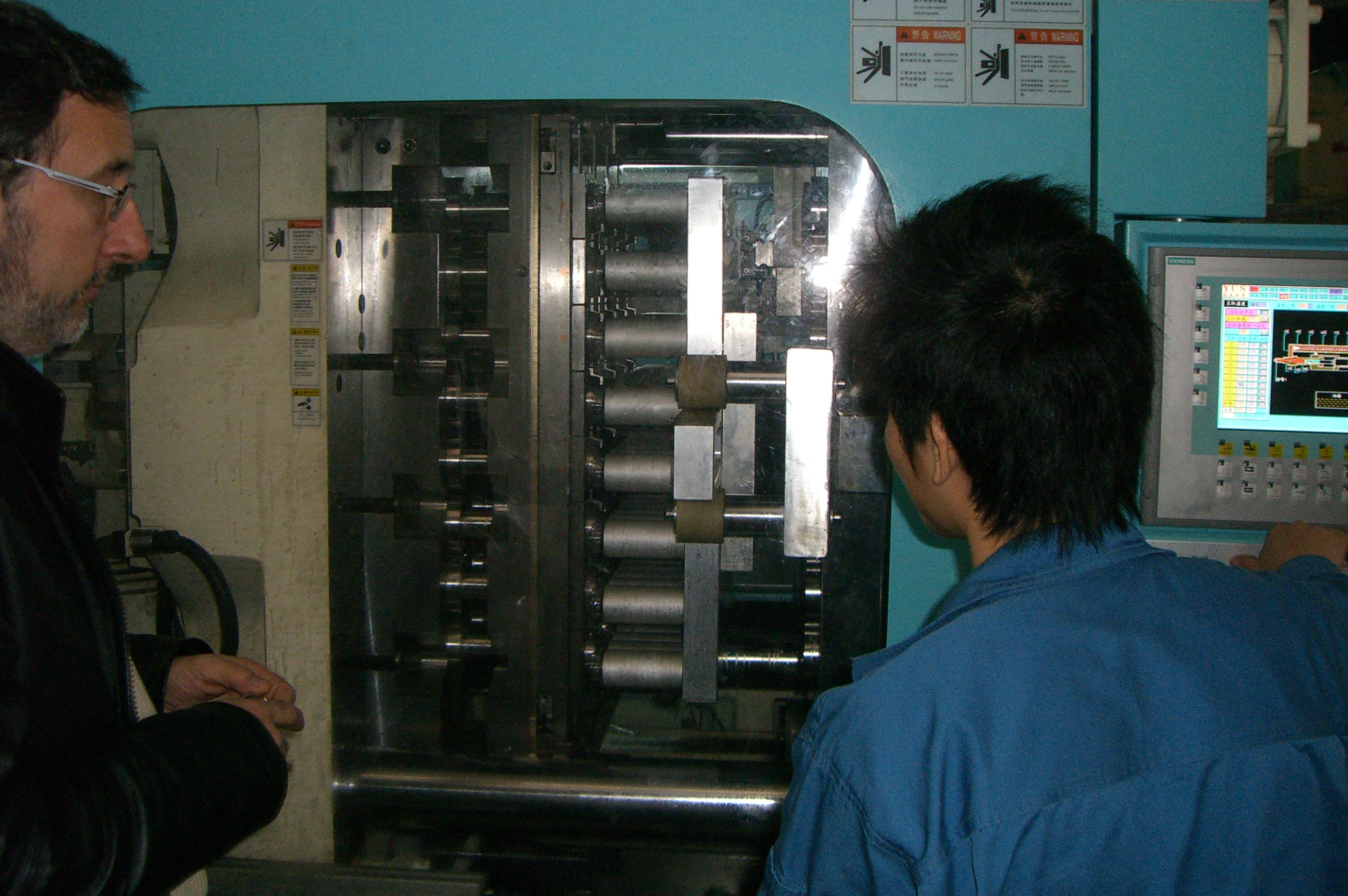
The mould was manufactured by Molmasa specially for the overmoulding process. The preform body, that in the first cycle is manufactured without a neck and with a wall thickness of 1.2 mm, has three small holes in the base area. These are a result of the core support, which prevents the cores from moving when filling the cavity. A patent application has been filed for this solution that guarantees the uniform wall thickness of the first layer. In the second phase, the preform bodies, which are still grey, are coated with a bright layer of white 2 mm thick. This produces a neck and thread and the three holes in the base are filled.


Customers for an outstanding development


In order to realise such innovative ideas it is essential to have interested customers. The application was thus presented to the company PDG Plastiques in France. This company is located next to the dairy filler LSDH and so is already familiar with the packaging of dairy products. PDG Plastiques was able to quickly blow the Prelactia preforms into bottles and subsequently test them. After six months 1000 bottles filled with UHT milk were assessed according to extremely strict criteria and demonstrated their superiority over mono-layer bottles. Not a single bottle revealed any tainting of the milk. This formed the basis for a successful collaboration with PDG on PRElactia and, in autumn 2007, PDG successfully commissioned its first Netstal system for the manufacture of PRElactia preforms.
The bottle’s pure white colour is immediately apparent when holding the final product in the hand, despite the grey inner layer. In contrast to the multi-layer method the dark inner layer does not show through. If the bottle is cut open, it is possible to see how well the materials have been matched. They bind firmly together making delamination impossible. The light measurements are particularly impressive and reveal a 99.99% absorption and reflection of light of up to a wavelength of 700 nm.


Hit Counter              


Process  plastic bottle   Blow Molding